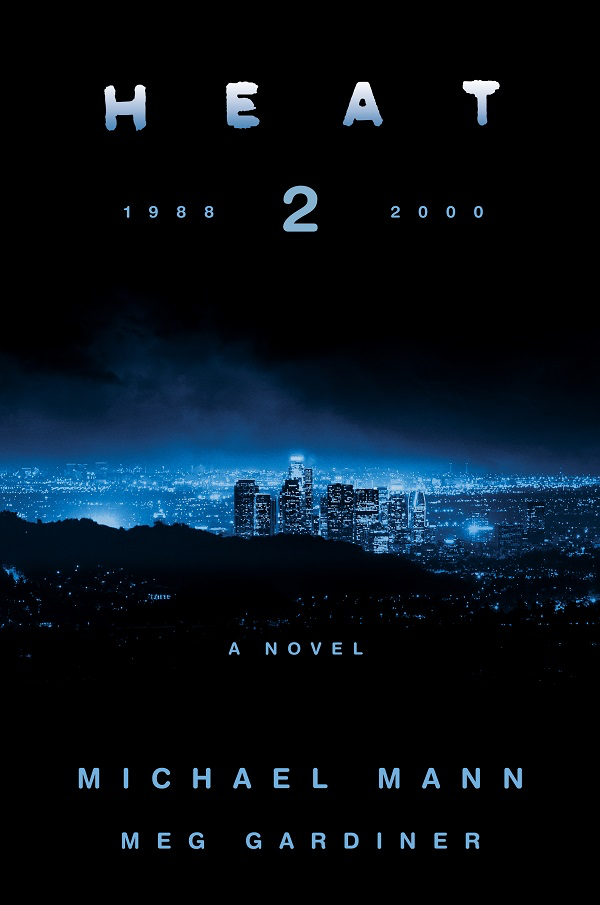
Although I use a clip from Michael Mann’s Heat (1995) in a first-year lecture to demonstrate the principles of classical continuity editing, it’s a while since I’ve watched any of the director’s films. However, I recently watched the fascinating new TV crime series Tokyo Vice, produced by Mann, who directed the first episode, and was prompted by this to pick up the novel Heat 2, which came out last year. While it is co-written with crime novelist Meg Gardiner, it has the tightly wound tension, minimal dialogue and thematic preoccupations that are found throughout his films.
Mann has a single-minded interest in men and, in particular, men engaged in certain types of work. He belongs to the generation who grew up hearing stories of their father’s generation, of the men (and women, although they are almost invariably omitted from these stories) who went to war. Mann would have grown up playing with toys, reading comics, watching films and TV series that all reframed the recent horrors of the second world war as heroic adventures. No doubt partly as a consequence of this, his own films are preoccupied with a particular mode of masculinity. They are peopled with protagonists who are professionals – skilful, emotionally cool, physically brave, and wholly dedicated to their jobs. While most of his films are action films that feature robberies, gun fights and chases, their real drama is derived from the battles fought by the heroes to maintain self-control and the repression of their emotions.
What distinguishes Vincent Hanna, the detective in Heat and Heat 2, from his colleagues, is his capacity to allow his emotions to come into play as if slowly opening a tap, popping a pill, or gently lifting his foot off the clutch, so that he can identify with, understand and anticipate the criminals he is chasing, and so that he can use his anger as a motivating force to carry him successfully through an investigation. The novel makes this even more explicit than the film through passages in which Hanna’s thoughts are relayed as internal monologue. His emotions are a resource, like his 12-gauge shotgun, that can be employed instrumentally to allow him to do his dangerous job more effectively. The FBI psychologist Will Graham, the protagonist in Mann’s film Manhunter (1986), uses a similar technique to find serial killers by empathising with them, getting inside their heads, although at the beginning of that film we learn that he suffered a breakdown while tracking down the murderous psychopath Hannibal Lecktor as he found he couldn’t get Lecktor out of his own head.
It is fairly likely that Mann identifies with these characters, understanding film-making in similar terms as a technically complex, professional process (and, no doubt, a man’s world). Vincent Hanna, and bank robber Neil McCauley (Heat), Will Graham, Vincent the hit man in Collateral (2004), Frank the safe-cracker in Thief (1981), John Dillinger the serial bank robber in Public Enemies (2009), and Nicholas Hathaway the hacker in Blackhat (2015) are all versions of a self-portrait. Although most of his films deal with crime, their protagonists occupy a different moral realm in which the real distinction between individuals is determined by their capacity for emotional repression. The weak, unreliable, and most contemptible characters are those who allow their emotions – avarice, fear, sadism, lust and desire – to overcome their rational calculations.
However, what makes his films interesting, and Heat 2 such a gripping read, is precisely that they are more than just proficient technical exercises. The unstable, precarious interplay of formal structures and destabilising affect is what can make them powerfully engaging (although I find some of his films such as Thief, The Jericho Mile (1979), The Keep (1983) and Miami Vice (2006), less engaging and more coldly crafted than others). The maxim of the criminal protagonist of Heat and Heat 2, Neil McCauley, is that criminal professionalism dictates that you have to be prepared to abandon everything in your life at a moment’s notice: ‘You wanna be making moves on the street? Have no attachments, allow nothing to be in your life that you cannot walk out on in 30 seconds flat if you spot the heat around the corner.’ The ‘heat’ is the police, but of course, in the context of Mann’s other films, it is clearly also feeling – the warmth and self-exposure of an emotional connection.
The publication of Heat 2 is a sign that Mann cannot apply this advice to himself. Wrapped around the original film as both prequel and sequel, the novel cuts back and forth between the lead-up to the events depicted in Heat and the aftermath of that film’s violent conclusion. It provides explanatory backstory to the film, fleshing out the characters so that, for example, we learn Hanna and McCauley are both Vietnam veterans who fought in the Tet offensive and the tunnels of Cu Chi. In fact, Mann’s entire body of work is built around reiterations of other works – adaptations of novels and TV series, as well as films that explore the repetitive clichés of American cinema genres. It’s not just that he can’t walk away but instead that he keeps coming back obsessively to the same themes and characters whether because he was dis-satisfied with the first pass, or because he sees the narrative as a pretext that allows him to immerse himself in the creative process of film-making. Or perhaps it’s because like, a minimalist composer, it is the play of repetition and difference itself that he finds most absorbing.
Heat was itself a reiteration, a remake of his1989 made-for-TV movie LA Takedown that uses more or less the same script and follows the same structure. LA Takedown includes almost identical shot sequences in some scenes, but it ends with a shocking abruptness, rather than with the epic finale of the film’s shootout at LAX airport. More than an hour shorter than Heat, and lacking the visual spectacle and the grandstanding, self-conscious star performances of Al Pacino and Robert de Niro, it’s a leaner, rougher, more dynamic and more realistic film. It was made as a pilot, and Mann later described it as a ‘first draft’ for Heat, but all the key elements are already there. Sumptuously beautiful as Heat is, it adds little to the first draft.
At a point in which American films are becoming ever larger, and increasingly reluctant to leave subtexts and subplots unexplained (what we might call the Lucas syndrome), the compressed narrative economy of a TV movie shot in 4:3 ratio is deeply attractive. This is not a matter of the celebration of a hyper-masculine hard-boiled narrative aesthetic from which all superfluous emotional drama has been removed, so much as the pleasure of well-crafted storytelling that is confident enough to leave gaps and withhold expository information. Poet and film theorist Vachel Lindsay complained in 1915, as feature-length films were beginning to become prevalent, that ‘There is not a good film in the world but is the better for being seen in immediate succession to itself. Six-reel programmes are a weariness to the flesh. The best of the old one-reel Biographs of Griffith contained more in twenty minutes than these ambitious incontinent six-reel displays give us in two hours.’ Over a century later it remains sound advice.
Of course, wanting to make moves on the street but unable to walk away yet again, Mann has announced he is already planning the film adaptation of Heat 2.
Reference: Vachel Lindsay (2000), The Art of the Moving Picture. New York: The Modern Library
 Bruce Bennett