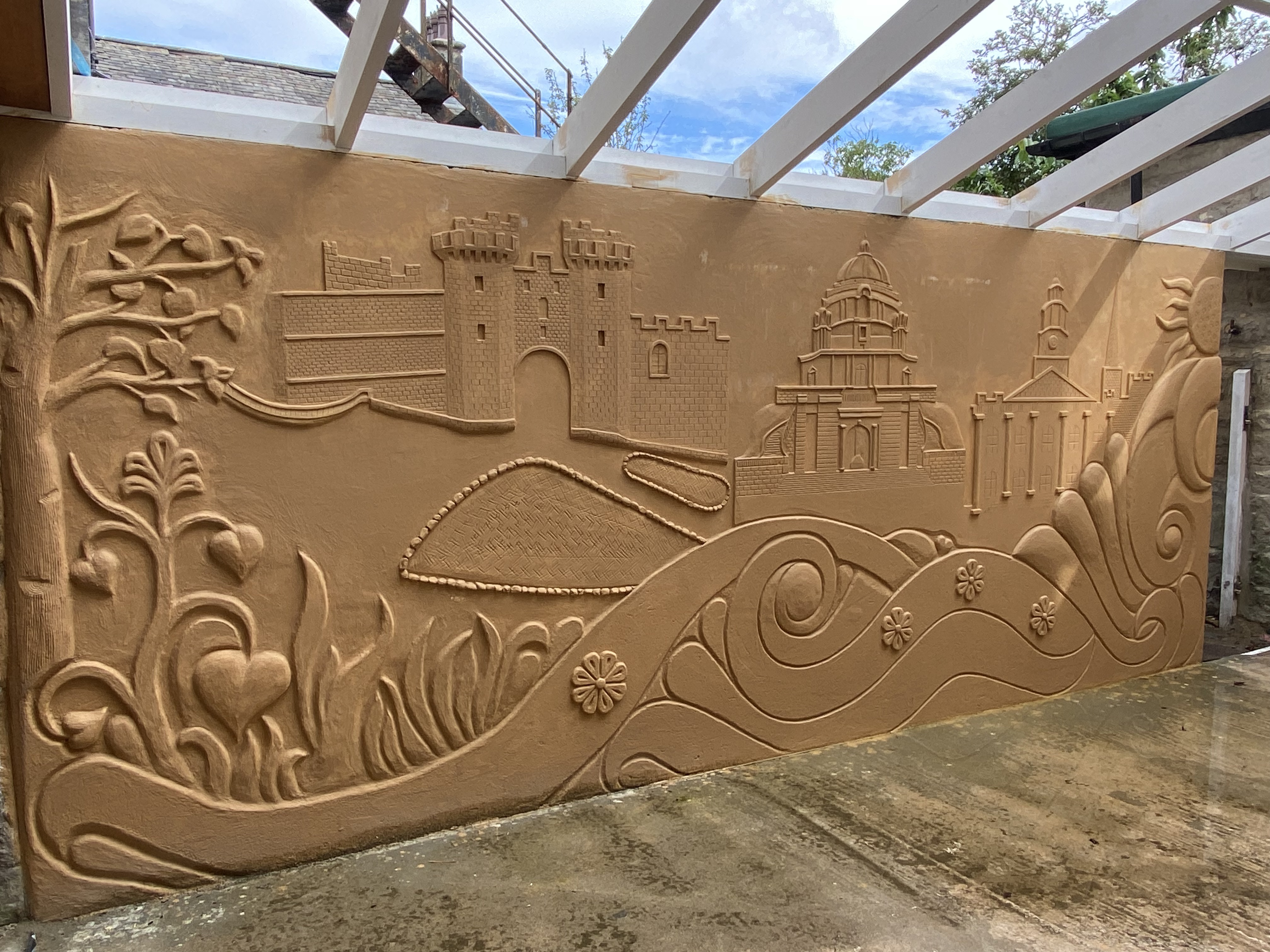
I have recently run a series of film-making workshops in conjunction with the Lancaster-based charity Global Link, which co-ordinates education programmes and welfare support for asylum-seekers and refugees in the area. The charity moved offices earlier this year, to a Georgian terrace near the centre of town. and speaking to their executive director last month, I learned that one of their clients was sculpting a concrete relief on the breezeblock wall in their new back yard. The house is a Grade II listed building and so, despite the fact it was on an existing wall that is virtually invisible from any surrounding buildings, a Conservation Department officer had told them they would have to demolish the wall, art-work and all (and also remove the historically inauthentic internal fire doors, plastering and fireboards from inside the building).
A week later, news reports emerged that after visiting the Kent Intake Unit, a reception centre for unaccompanied child asylum seekers, the Immigration Minister, Robert Jenrick, who appears to have embraced the racist, fear-mongering rhetoric of the right, had instructed the staff there to paint over murals showing Disney cartoon characters, because they were too welcoming. Like much of current government policy, this is a performative gesture of racist hostility towards the disenfranchised and the powerless, designed to excite the right-wing news media and the small cohort of right-wing voters that might carry them to power in the next general election.

- cartoon from Private Eye, no. 1602. 14-27 July, 2023
To be a refugee is to be confronted with walls, fences and boundaries that are physical, and also borders that are less directly visible but perhaps equally difficult to negotiate – such as the bureaucratic obstacles asylum-seekers encounter when applying for leave to remain, the discrimination and abuse they might face in day-to-day encounters with the settled population, as well as simple cultural difference. Thus, while Jenrick’s instruction to the staff at the reception centre in Kent may seem casually sadistic, it demonstrates an understanding of the symbolic significance of walls within the political theatre of refugee processing. Having made it across the channel on boats, trucks or trains, asylum-seekers arriving in Britain, should be met with blank walls. These unadorned surfaces will convey to them that Britain is indeed the ‘hostile environment’ that Home Secretary Theresa May declared in 2012 the government intended to create, an approach that is designed to make life in Britain so uncomfortable for asylum seekers (regardless of their circumstances) that many will be driven to leave while others will be deterred from coming to the UK in the first place.

The relief in Lancaster is a beautiful piece of work, placing some key buildings from the city within a decorative frame of waves, flowers, and trees. Far from depicting Lancaster as a hostile environment, it portrays it as a sunny, welcoming space, and this warm tone is underlined by the heart-shaped leaves on the bush in the corner. That the artist can show it in this way is a touchingly positive sign that Lancaster isn’t necessarily experienced by asylum-seekers as the hostile environment that the government and the right in Britain would like it to be. It attests to the value of the support work that Global Link does (and, pleasingly, the instruction to demolish the wall was subsequently reversed).
The work is also an expression of the wasted creative potential and the skills and energy of those people who’ve come to Britain to try to start a new life, but are unable to work and are confined to the social margins as a result. Perhaps what is most significant is that this is not just a painting or sculpture but is a wall-work. The artist has taken an unremarkable breeze-block wall, a symbolic barrier or boundary, and transformed it into a work of art. In 2005 the British artist Banksy travelled to Israel and painted murals on sections of the colossal concrete border wall Israel has built around the West Bank.

The most striking of these create a trompe l’oeil effect, and appear to show holes in the wall with blue skies, a tropical beach or a picturesque mountain range visible on the other side. These works are a form of symbolic intervention, altering the meaning of the wall on which they’re painted. They turn that vast, blank object that is intended to separate people and close off communication and the exchange of ideas, into a representation, into an image that puts ideas into circulation and reopens channels of communication. This artwork made quietly by an asylum-seeker in a backyard in Lancaster does something similar, if on a smaller, less public scale. It transforms a wall – a symbolic border – into a hopeful symbol of togetherness and welcome.
 Bruce Bennett