Last weekend I had the opportunity to see a rare screening of Stanley Kubrick’s Full Metal Jacket (1987) as part of the wonderful Bay International Film Festival in Morecambe, organised by Anna Kumacheva, who has recently graduated with a PhD from my department at Lancaster University. Rewatching the film for the first time in years, it is very clear that it is less concerned with an investigation of the circumstances of the Vietnam war than it is with the violent process of institutionalisation. The film details the process by which young male recruits are trained to become killers through relentless, humiliating bullying in an environment of conformity, racism, misogyny and eroticised violence (an idea that is captured in the punning title of a 1990 song by Jello Biafra about the racialised violence of the crack epidemic raging in US cities, ‘Full Metal Jackoff’). The events of the first half of the film are confined to a base the recruits refer to as ‘the island’, and we see nothing of this abstracted, hemetically sealed space beyond the parade ground, the assault course and firing range, the dormitory, and the ‘Head’, the white tiled toilet, which recalls the luminous spaceship interiors of 2001: A Space Odyssey (1968), the minimalist brutalist architecture of A Clockwork Orange (1971), the labyrinthine halls and corridors of the overlook hotel in The Shining (1980), and the vast war-room in Dr Strangelove (1964) designed by Ken Adam. While much attention was paid to the miraculous reconstruction of Vietnam in the environs of London by production designer Anton Furst, the most dramatically important location in the film is the toilet that resembles an operating theatre, mortuary or slaughterhouse. Knowing that Kubrick’s favourite colour scheme is red and white, we can anticipate that it is only a matter of time before this comically surreal space (which also invokes the perverse dining room in Luis Buñuel’s The Phantom of Liberty (1974)) will be redecorated with blood.

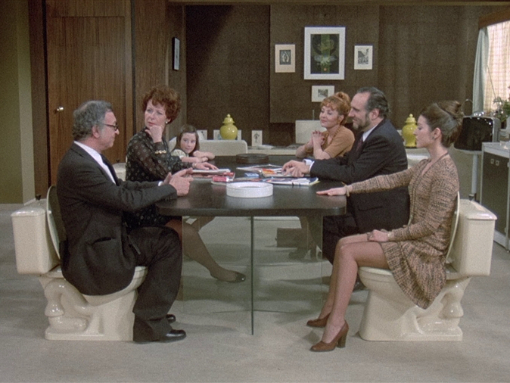
The Head in Full Metal Jacket and the dining room in The Phantom of Liberty
The fact that the film was shot in Britain underscores the sense that Kubrick was more interested in the way in which this narrative scenario could serve as a generalised environment than he was with historical specificity. The film has more in common with films about corporate offices, prisons, psychiatric hospitals, borstals and boarding schools than with Vietnam war films. Indeed, in its concentration upon the way in which absurd, maddening repetition functions as the principal pedagogical method – through drilling, cadence chants, and pointless activities – the first half of Full Metal Jacket is effectively a reworking of the opening scene of Chaplin’s satire Modern Times (1936), in which the tramp is driven to hysteria by working on a factory assembly line.
The second half of Full Metal Jacket rejoins two of the recruits, now ‘in country’ in Vietnam in the period leading up to the Tet offensive of 1968. While the first half outlined the violent and dangerous process by which they were fashioned into substitutable components of the war machine, the second half outlines the consequences of this as they come face to face with the reality of war. However, although this is a film about education, there is little sense that any learning takes place. Indeed, in the film’s final scene, following a brutal, spectacular battle through the concrete ruins of a city, the surviving marines march through the burning rubble happily singing the theme song to the children’s TV series, ‘The Mickey Mouse Club’. Far from having matured and arrived at a reckoning, they have regressed to childhood, allowing the film to draw a line from the practices of US consumer culture to the dehumanizing methods of basic military training.
If the film has a protagonist, it’s Davis, nicknamed ‘Private Joker’ by the drill instructor. Joker delivers occasional passages of expository voiceover commentary, but these are almost an afterthought when compared with the crucial function of voiceover in Barry Lyndon (1975) or A Clockwork Orange. Joker, who is assigned the role of reporter for US military newspaper Stars and Stripes, is a narrative device or avatar who observes events around him with an ironic, arrogant detachment and provides a link between different sections of the film in the absence of conventional narrative continuity.
Discussing working with Kubrick on the adaptation of one of his short SF stories that later became AI (Spielberg, 2001), Brian Aldiss recalled that Kubrick thought of film narratives not as a linear thread but as a series of ‘non-submersible units’, arranged in sequence, like book chapters or episodes in a serial. This architectural concept of a film as a row of autonomous modules is most fully realised in the divided structure of Full Metal Jacket. At one point, Joker explains to an incensed general that he is wearing a peace badge while sporting the slogan ‘Born to Kill’ on his helmet in order to make a point about the ‘duality of man, the Jungian thing’. The film has little interest in the interiority of its characters – they are hollowed out mechanisms – and so this comment offers no real insight into the film’s understanding of the psyche. It does, however, lay bare the binary mechanism of the film itself. Full Metal Jacket is a film comprising two disarticulated parts, scored by a soundtrack of two parts – trashy 1960s pop juxtaposed with eerie electronic music. The central theme of the film is thus process. It exposes the brutal means by which young men are reduced to killing machines, and in the process of making these observations, the film also exposes its own mechanism, demonstrating that the film – like all films – is not an organically fluid narrative, but a schematic, absurd and thoroughly artificial assemblage. In this respect it has much more in common with modernist artworks that take the status of the medium – their own conditions of possibility – as their subject, than with classical Hollywood cinema which is concerned with effacing the traces of its manufacture.
A rare moment of compassion within the hellish context of the training camp comes in the first half of the film where Joker is teaching one of the other recruits, the tragically inept Leonard Lawrence, how to strip down and reassemble his rifle, the process recounted in Henry Reed’s 1942 poem, ‘Naming of Parts’. Later on, it is when Joker finds him talking lovingly to his rifle as he disassembles it that he realises Lawrence has begun to lose his grip on sanity in the face of relentless bullying from the drill sergeant. The naming of parts has morphed from pedagogical method into symptom of insanity. In the climactic scene of the film’s first half, Joker finds a clearly deranged Lawrence sitting alone in the toilet – enmired in what he terms ‘a world of shit’ – still talking to his weapon as he loads the magazine with bullets: ‘762 millimetre, full…metal…jacket.’

Private Leonard Lawrence ‘in a world of shit‘
The critical reception of this film has tended to suggest it was a broken-backed misjudgement, as if Kubrick couldn’t settle on how to approach the topic. However, in the Q&A after the screening, Kubrick’s friend and producer Jan Harlan recalled that Kubrick worked slowly because he was highly self-critical. His comment suggests that the decisions made about this film were deliberate, and that this is a film that is consciously engaged with the naming of its own parts. In drawing our attention to its structure, it acknowledges the artificiality of its narrative mechanism and the utter inadequacy of cinematic storytelling systems in the face of the horrors and the moral and historical complexity of war.

Jan Harlan (right) in conversation with screenwriter Graham Duff
 Bruce Bennett